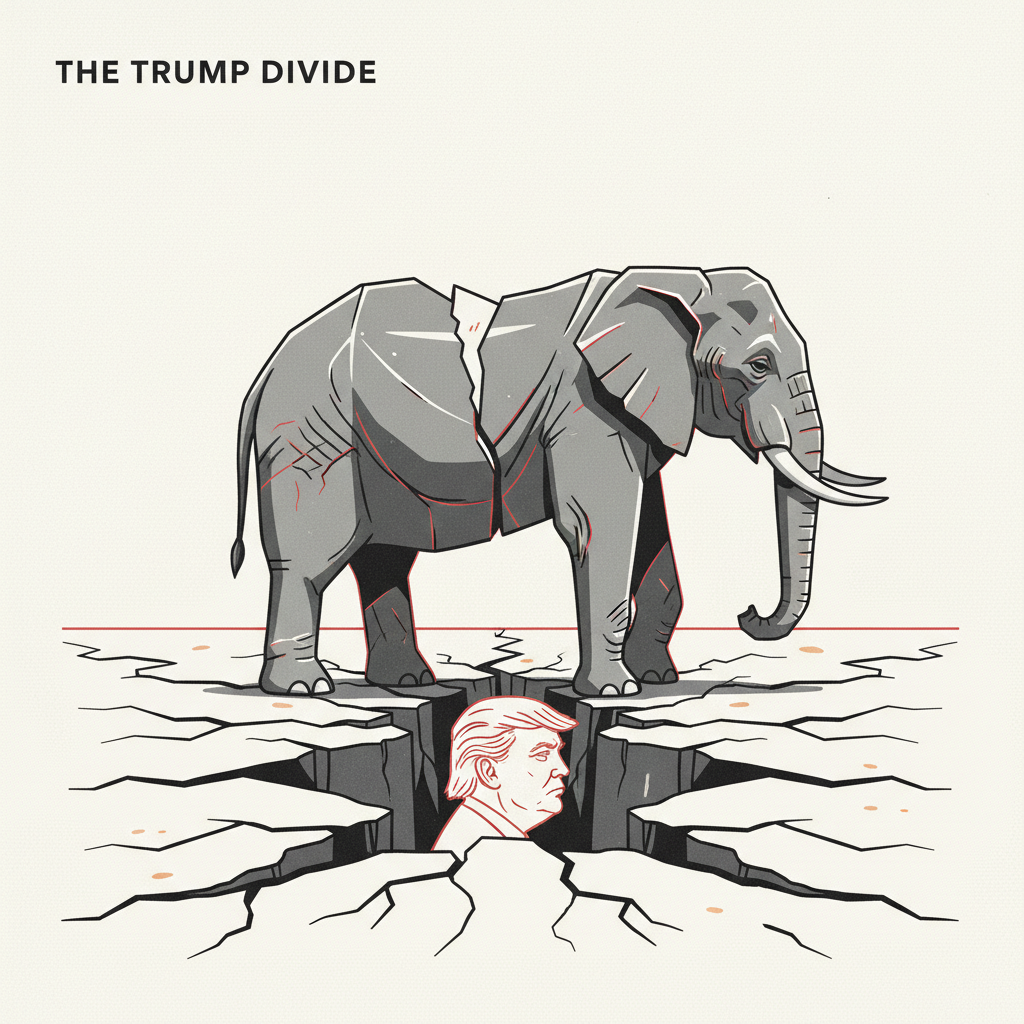
In a surprising display of political autonomy, more than a dozen Republican state senators in Indiana defied the explicit wishes of former President Donald Trump, voting against a proposed congressional redistricting map. This unexpected move highlights a simmering tension within the Republican Party, even in a solidly red state like Indiana, where the GOP holds an overwhelming majority in the state Senate.
Trump’s post-presidency influence has often been perceived as absolute within the Republican ranks, with state and local party organizations generally aligning with his directives. However, this incident in Indiana serves as a significant crack in that narrative. The proposed map, which aimed to strategically bolster Republican representation in the U.S. Congress, was designed to create additional safe seats or make existing competitive districts lean more heavily Republican. Such efforts are common after a census, but the forceful, top-down push for specific outcomes, allegedly from the former president’s camp, appears to have met an unexpected roadblock.
The reasons behind the Hoosier state senators’ defiance are multifaceted. Political analysts suggest several contributing factors. Firstly, local control and incumbent protection often take precedence over national party mandates. Many state senators are keenly aware of their constituents’ needs and the delicate balance of their own districts. Pushing a map that could disrupt existing political structures or even inadvertently threaten a fellow state-level Republican’s re-election chances might have been seen as a greater risk than aligning with Trump’s wishes. There’s also the element of potential primary challenges; senators might be wary of supporting a controversial map if it could invite a well-funded primary opponent in their next election cycle.
Secondly, while Indiana is a conservative state, its brand of Republicanism has historically shown a pragmatic and somewhat independent streak. Unlike some states where fealty to the national party line is unquestioned, Indiana Republicans have occasionally demonstrated a willingness to chart their own course, particularly when state-specific interests are at stake. This could be a manifestation of that independent spirit, where local legislative priorities and constitutional considerations, such as ensuring fair representation or avoiding gerrymandering that could face legal challenges, outweighed external pressure.
The ‘more than a dozen’ senators who cast dissenting votes likely represent a cross-section of the party, from long-serving members prioritizing legislative stability to perhaps more moderate voices concerned about the optics or long-term consequences of an overly aggressive gerrymander. Their collective action sent a clear message: while Trump remains a significant figure, his influence is not universally absolute, even among the party faithful.
The political implications of this rejection are substantial. For Trump, it represents a visible and public snub, challenging the perception of his unshakeable grip on the Republican Party. For the Indiana GOP, it highlights internal divisions that could fester, potentially leading to future intra-party skirmishes or a re-evaluation of how much deference is given to national figures. On a broader scale, this event could signal a growing willingness among state-level Republicans across the country to assert their own priorities, potentially leading to more localized and less uniformly nationalized redistricting efforts in the future. The ultimate impact on Indiana’s congressional delegation remains to be seen, but this act of defiance undoubtedly reshapes the political landscape.